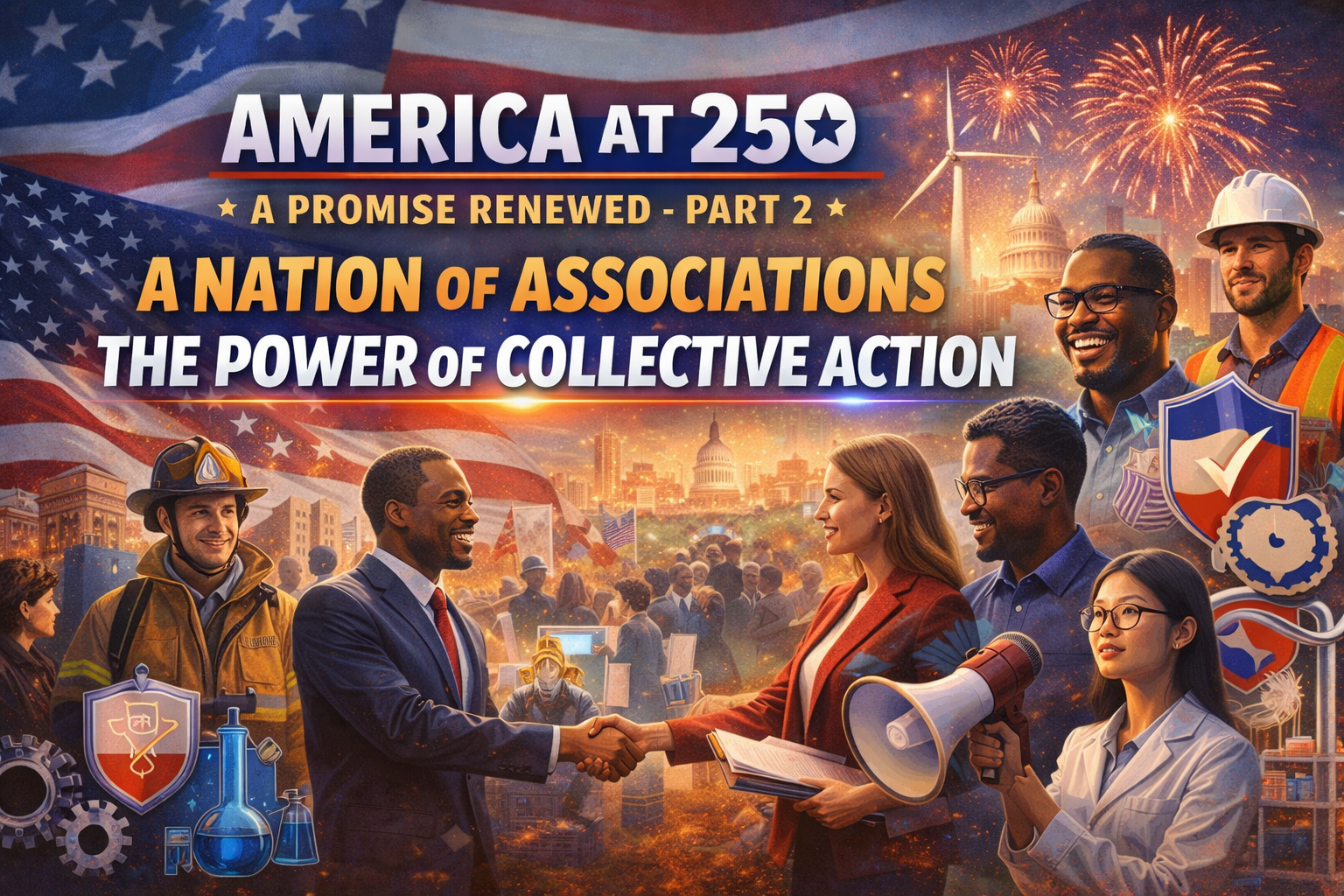
America’s progress has always been collective. We mythologize rugged individualism, but we live by organized interdependence. Associations are where that interdependence becomes intentional: where knowledge is codified, standards are established, ethics are enforced, careers are developed, and voices are amplified. If democracy is the operating system, associations are some of its most important applications.
When I look across our community, I see examples everywhere. A professional society raises the bar for training and certification, making the public safer and the profession stronger. A trade association sets voluntary standards that become industry norms. A membership organization connects early-career professionals with mentors who change trajectories. A coalition persuades policymakers to remove an artificial barrier to entry. These are not marginal contributions; they’re the scaffolding of progress.
And when we talk about “all men are created equal,” associations can be the mechanism that widens the gate. If talent is universal and opportunity is not, then our work is to bring opportunity closer to where talent lives—across geography, background, age, and circumstance. We do that through scholarships and apprenticeships, open-access knowledge, regional chapters, and standards that create fair competition and transparent pathways to advancement.
Collective action is also how we tackle challenges that no single organization can solve alone, such as public trust, workforce pipelines, data integrity, safety, and sustainability. The problems of scale demand solutions of scale. Associations are built for this moment—nonpartisan, mission-driven, and pragmatic.
As we approach the 250th anniversary, we should lean into this power with purpose:
- Create shared agendas with peer associations around equality of access in your sector—an inter-association compact with commitments you’ll measure and report.
- Stand up “civic labs” that pilot new ideas quickly: credentialing alternatives, micro-internships, community-based pathways into the profession.
- Elevate members as citizen-leaders, offering resources for local engagement, school partnerships, and public education on your field’s contribution to the common good.
We don’t need permission to lead. We already have the trust, the reach, and the infrastructure. The promise of America requires institutions that are worthy of it. Associations can be the proving grounds where ideals are converted into practice at scale.