Let me offer a perspective that may feel uncomfortable at first:
Most associations are not constrained by strategy; they are constrained by capacity.
We have spent decades refining strategic plans—wordsmithing priorities, crafting vision statements, and building multi-year roadmaps. Yet many of these plans quietly stall, not because they are flawed, but because the organization lacks the infrastructure to carry them forward.This is where we need to shift our thinking.
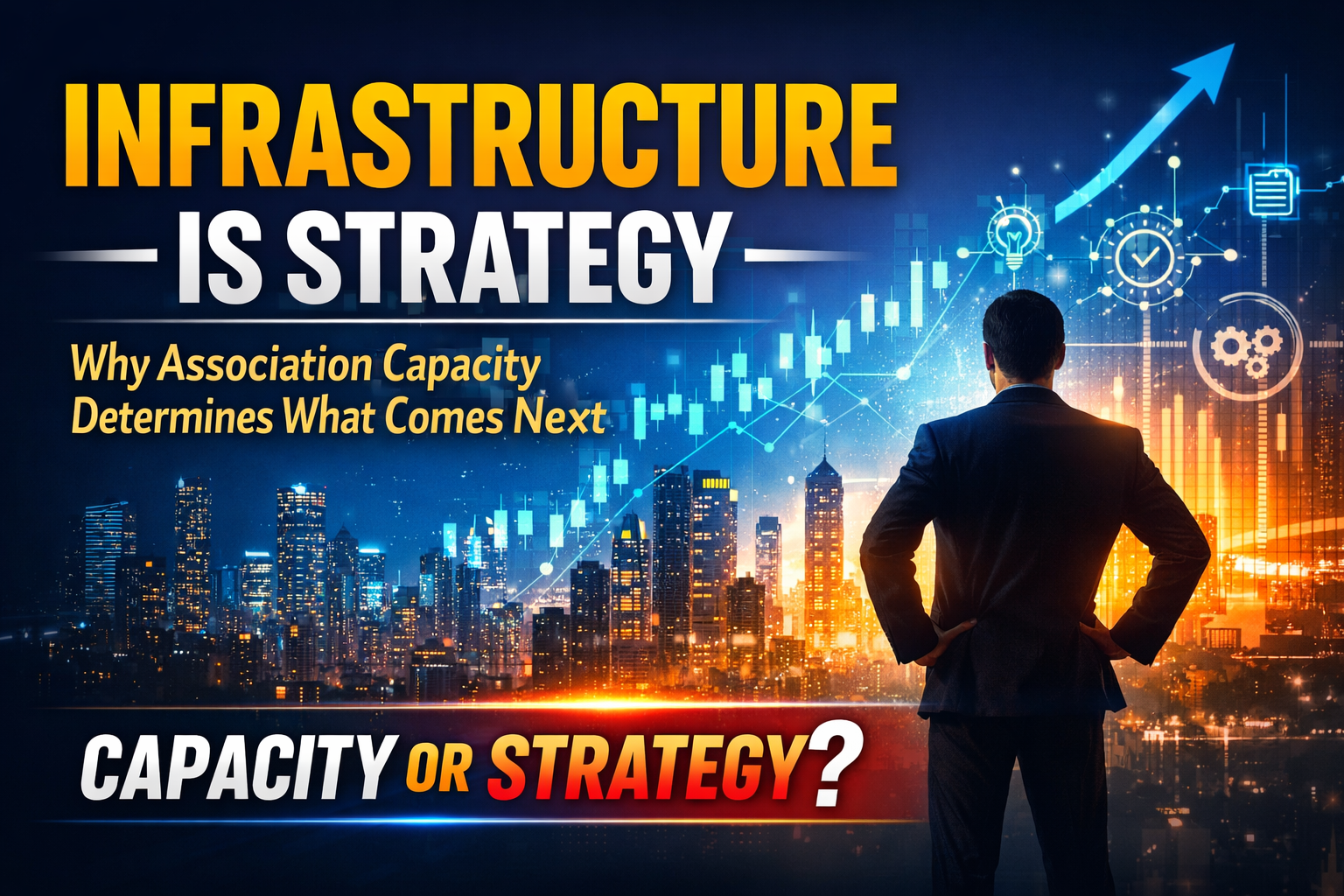
Association infrastructure is not administrative. It is strategic.
In fact, infrastructure is capacity. And capacity is what ultimately determines whether a strategy lives or dies.
When I talk about infrastructure, I am not referring only to technology systems or organizational charts. I am talking about the integrated capabilities that allow an association to sense, decide, and act in a changing environment.
This is precisely where the Seven Strategic Capacities come into focus.
- Curiosity and Strategic Thinking form the sensing mechanism—how well you understand what is changing and why it matters.
- Foresight and Governance shape decision-making—how effectively your board and leadership anticipate and prepare for multiple futures.
- Operational Integrity ensures that trust, transparency, and execution discipline are embedded in everything you do.
- Program Delivery reflects your ability to translate ideas into value that members can see and feel.
- Reputational Impact determines whether your voice is credible, relevant, and influential in a crowded landscape.
- Resource Development fuels sustainability—not just financially, but also through partnerships and long-term viability.
- Talent Development and Technology Proficiency enable your organization to scale, adapt, and continuously learn.
Taken together, these are not abstract concepts. They are your infrastructure.And here is the critical insight:
You do not execute a strategy on top of infrastructure.You execute strategy through infrastructure.
If your governance model is slow and compliance-driven, your strategy will be slow and reactive.
If your technology is fragmented, your member experience will be fragmented as well.
If your culture does not support learning, your organization will repeat the past—no matter how bold your strategy sounds.
This is why many associations feel stuck. They are trying to produce 21st-century outcomes with 20th-century infrastructure.
In a BANI world—brittle, anxious, nonlinear, and incomprehensible—this gap becomes even more dangerous. The environment is not waiting for us to catch up. It is accelerating.So the question is no longer, “What is our strategy?”The better question is:“Do we have the capacity to do what our strategy requires?”That is a very different conversation.It shifts the focus from planning to building. From intention to capability. From aspiration to execution.And it changes the role of leadership.
Boards must move beyond fiduciary oversight alone and embrace foresight as a core responsibility.Executives must move from managing operations to intentionally building organizational capacity.Teams must be equipped not just to deliver programs, but to adapt, learn, and evolve.This is the work.
In the coming blogs, I will explore what this means in practical terms—how associations can assess their current infrastructure, identify the most common gaps, and begin strengthening capacity without overwhelming already-stretched teams because the associations with the best plans will not shape the future.
It will be shaped by the associations with the strongest capacity to act.And that is a choice.
Let me know what you think.