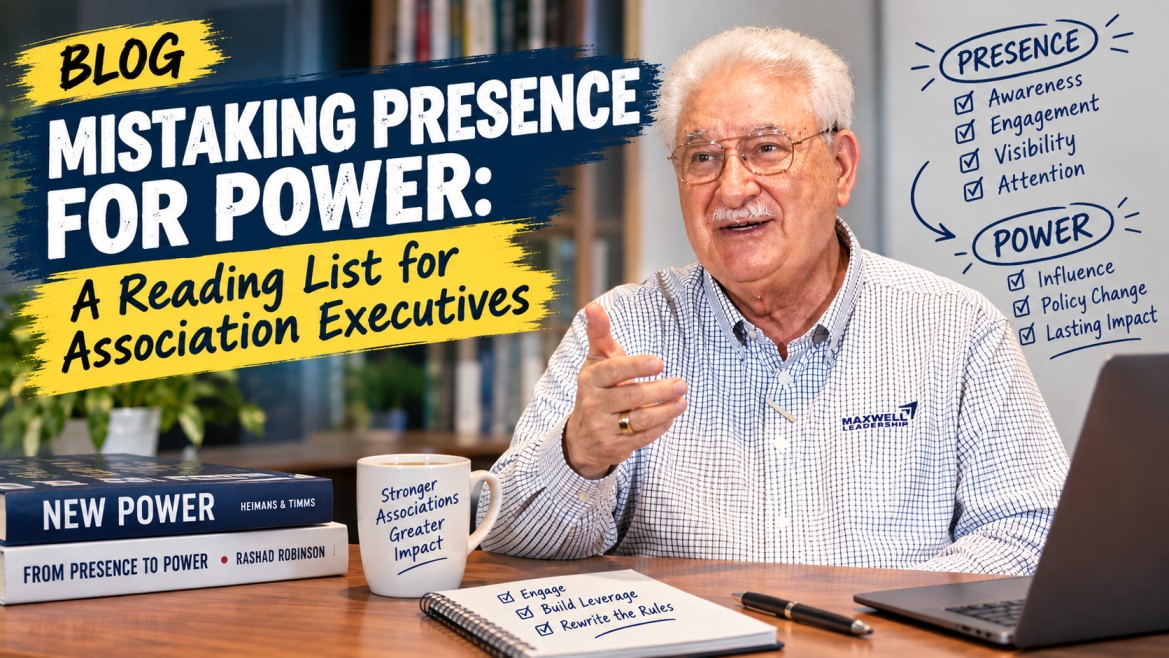
I read two books back-to-back this summer that turned out to be arguing the same point from opposite directions: Jeremy Heimans and Henry Timms’s New Power: How Power Works in Our Hyperconnected World—and How to Make It Work for You (Amazon)(1), and Rashad Robinson’s From Presence to Power: How to Take On the Fights That Matter—and Win (Goodreads)(3). One is about where power comes from now. The other is about how easily we confuse power with something that only looks like it. Read together, they describe almost exactly the trap associations have been falling into for a decade—and the trap gets more expensive every year we don’t name it.
The Conference Was a Sellout—the Standard Still Got Gutted.
Picture an association that had a very good year. Record attendance at the annual conference. A LinkedIn following that doubled. The CEO was quoted in three national trade outlets. The membership committee circulated the engagement numbers in the year-end report like a trophy. Then a state legislature took up a bill that would gut the licensing standard the association had spent two decades building and defending. The association submitted testimony. It mobilized members to write letters. The standard got gutted anyway, on a voice vote, with barely a mention of the association’s name in the floor debate.
Nothing about that story is unusual. It happens to associations every legislative session, in nearly every state. And it happens because the association had built enormous presence and mistook it for power.
Presence Is Not Power
That distinction, the whole title of Robinson’s book, comes from his years running Color Of Change, where he built what he describes as an explicit internal framework: “We have a framework at Color Of Change of not mistaking presence for power. Presence is ability; it’s awareness; it’s retweets; it’s people talking about your issue. Power is the ability to change the rules. You only get to power through action” (5). On the page, he sharpens it further: presence is being seen, counted, invited into the room, and thanked publicly—it creates urgency but does not, by itself, change anything. Power is “the ability to decide what others must do next,” exercised through laws, funding habits, professional standards, and the countless quiet rules that determine whose concerns get taken seriously (Goodreads)(4). His argument, restated for a trade or professional association: “We don’t win by showing up; we win by building the leverage required to rewrite the rules”(6).
Read that back against the conference-attendance-and-LinkedIn-followers association. Every metric in that year-end report measured presence. None of it measured the capacity to change a vote.
Old Power Was Never the Whole Answer Either
Heimans and Timms come at the same problem from the supply side. They describe “old power” as operating like currency: held by a few, hard to gain, and spent once used—the credential-granting, hierarchy-protecting, insider-access model most associations were built around a century ago (2). “New power,” by contrast, behaves like a current: open, peer-driven, and dependent on active participation rather than credentialed authority. It doesn’t ask people to defer to an institution’s standing; it asks them to build something together and claim a stake in it (3).
The trap for associations isn’t that old power is obsolete—credentialing, standard-setting, and professional gatekeeping are still core to what many associations legitimately do. The trap is assuming that old power’s legitimacy still automatically converts into influence outside the association’s own walls. It doesn’t anymore. A regulator, a legislator, or a member firm’s own younger staff is just as likely to trust a peer network, a hashtag campaign, or a competing credentialing body as they are to trust a hundred-year-old seal of approval.
Heimans and Timms map this onto what they call the participation scale, moving organizations from consumption to collaboration, to co-ownership (2) . Most associations still operate near the consumption end: members pay dues, attend the conference, read the newsletter. Very few have built real collaboration, and almost none have built co-ownership. That’s the gap New Power is pointing to, and it’s a different gap than the one Robinson is pointing to — but they close at the same address.
I’d add one more layer specific to our sector: associations often hold old power without realizing they’re spending it down. A certification a board approved thirty years ago, a seat at a federal advisory table won by a predecessor two executive directors ago, an exclusive relationship with a licensing agency inherited rather than earned—these read as durable assets on an org chart, but Heimans and Timms’s framing is a warning here. Old power, held by a few and hard to regain once lost, doesn’t renew itself just because no one has challenged it yet (2). The associations getting outflanked right now are rarely losing a fair fight to a louder new-power competitor. More often, they never noticed the old-power asset was quietly expiring, because nothing about it required renewal to keep showing up on the strategic plan.
Where the Two Books Meet
Here’s the synthesis I keep coming back to: new power, on its own, only produces presence. A vibrant online member community, an engaged social following, a well-attended hybrid conference — these are new-power wins, and associations should absolutely keep building them. But per Robinson’s framework, none of that becomes power until it converts into the capacity to change a rule: a regulation, a reimbursement policy, an accreditation standard, a corporate practice inside member companies. An association can master every new-power tactic in the book and still lose the legislative fight, because presence and power are measured on entirely different axes.
The associations winning right now are doing both on purpose. They’re building new-power participation — member-led task forces with real decision authority, public comment campaigns that put member voices directly in front of regulators, co-created research that member organizations can point to as their own — and they are explicitly designing that participation to end in a leverage point: a testimony record, a coalition vote, a media cycle timed to a legislative calendar. Presence becomes power the moment someone with the authority to change a rule has to respond.
What This Should Change About Monday Morning
A few questions worth putting in front of your board or your senior team, drawn straight out of both books:
- Pull your last three “big win” reports to the board. How many of the headline metrics measure presence — attendance, followers, opens, downloads — versus power — a rule, policy, or standard that actually changed because of your association?
- Where on the participation scale does your flagship member engagement effort actually sit — consumption, collaboration, or co-ownership? Be honest; most associations overestimate this by one full category.
- Name the last regulatory or legislative fight your association entered. Did you show up with testimony, or did you show up with leverage — a coalition, a voting bloc, a media relationship, a credible threat to withhold something the other side needed?
- If a member-led online community outside your association’s walls started setting the de facto standard in your field tomorrow, what would you have to change about your own new-power investment to stay relevant?
None of these have comfortable answers on the first pass. That’s the point of reading both books together instead of picking one lane.
An Invitation, Not a Conclusion
I don’t think either book hands associations a finished playbook — Heimans and Timms are writing for a much broader canvas than professional associations, and Robinson is writing from the front lines of racial-justice organizing, not membership dues models. But the through-line is too clean to ignore: presence has never been cheaper to build, and power has never been won more exclusively through deliberate, structural leverage than through visibility. Every association executive I know is already sitting on more presence than any generation before them had. Very few of us have converted enough of it into power.
That’s exactly why I think both books belong on the same reading list, not filed under separate departments—one under “communications” and the other under “advocacy.” Presence and power are not sequential steps where you finish building an audience and then, separately, decide to get political. They’re two different currencies that the same leadership team must manage on the same timeline, with the same board-level attention. An association that treats New Power as a social media strategy and From Presence to Power as a government relations manual will build two disconnected muscles instead of one coherent capacity.
I’d genuinely like to hear where you land on this. Where has your association mistaken presence for power — and where have you actually managed to convert one into the other? Leave a comment below; I’ll be reading and responding, and I suspect the best answers here will come from the field, not from either book.
Sources
- Jeremy Heimans and Henry Timms, New Power: How Power Works in Our Hyperconnected World—and How to Make It Work for You: https://www.amazon.com/New-Power-Works-Hyperconnected-World/dp/0385541112
- ACMP SoCal Chapter, “What We’re Reading: New Power by Jeremy Heimans and Henry Timms”: https://www.acmpsocalchapter.org/post/what-we-re-reading-new-power-by-jeremy-heimans-and-henry-timms
- Blinkist, “New Power: Summary of Key Ideas and Review”: https://www.blinkist.com/en/books/new-power-en
- Rashad Robinson, From Presence to Power: How to Take On the Fights That Matter—and Win: https://www.goodreads.com/book/show/241483181-from-presence-to-power
- The Wake Agency, “Color Of Change President Rashad Robinson on Presence Versus Power”: https://www.thewakemanagency.com/insights/color-of-change-president-rashad-robinson-on-presence-versus-power/
- Yahoo Finance, “Rashad Robinson Releases From Presence to Power, a Strategic Blueprint for Winning Structural Change”: https://finance.yahoo.com/small-business/articles/rashad-robinson-releases-presence-power-130000085.html