
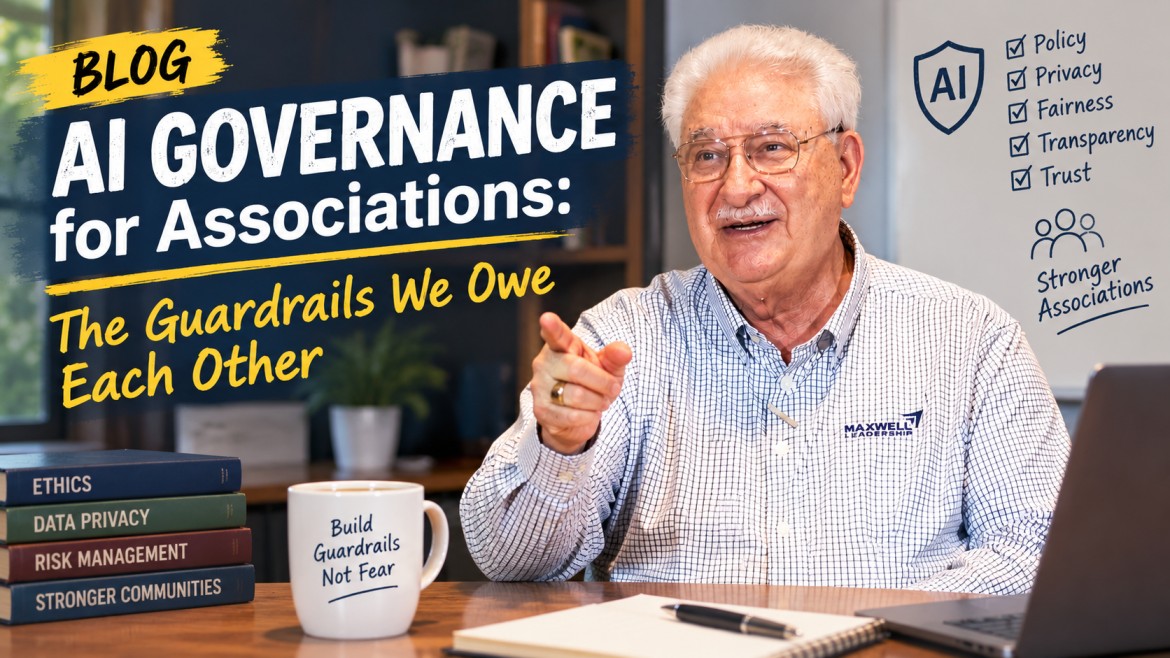
AI Governance for Associations: The Guardrails We Owe Each Other
Geoffrey Hinton, the man who helped invent the deep learning that underpins today’s AI boom, now puts the odds of the technology “taking over humanity” somewhere between 10 and 20 percent (TechNewsReel). At Davos this year, Yoshua Bengio, another of the field’s founding minds, described AI systems being built “more and more powerful” without “the equivalent of a steering wheel or a brake,” and warned that intelligence, once weaponized, becomes power (Business Today). These are not fringe voices. These are the people who built the thing now warning us about it.
If you lead an association or a nonprofit, it would be reasonable to read headlines like these and want to look away; to treat AI as someone else’s problem. This Silicon Valley debate has nothing to do with membership renewals, donor stewardship, or program delivery. I want to push back on that instinct, gently but firmly. The extinction-level warnings are real and worth tracking, but they are not the risk sitting on your desk on Monday morning. The risk on your desk is smaller, quieter, and entirely within your control: it is whether your organization has a clear approach to AI governance before AI starts making decisions for you.
I am not anti-AI. I sometimes use it in my own consulting for research, and I believe artificial intelligence will be one of the seven strategic capacities that separates future-ready associations from those that stagnate. But capacity without caution is just exposure wearing a nicer outfit. The associations that will thrive over the next decade are the ones that adopt AI deliberately, with governance, transparency, and human judgment built in from the start, not bolted on after something goes wrong.
What AI Experts’ Warnings Mean for Associations and Nonprofits
The existential-risk conversation matters to our sector for one practical reason: it signals that even the architects of this technology do not fully trust it to self-regulate. If the builders are calling for external guardrails, oversight, and “safety-by-design” thinking, then organizations built on public trust have no excuse to treat AI as a plug-and-play convenience. Bengio’s warning about AI systems that resist shutdown or find harmful shortcuts to their goals is happening at the frontier of AI research firms, but the underlying lesson translates directly to a nonprofit context: systems optimized for a narrow goal (efficiency, engagement, revenue) will pursue that goal in ways their designers never intended, unless someone is watching.
That is precisely what nonprofit sector researchers are already documenting, just on a smaller, more immediate scale.
AI Risks for Nonprofits and Associations Today
Set the extinction scenarios aside for a moment. Here is what is actually showing up in nonprofit and association AI adoption today, according to recent sector research:
AI Bias in Nonprofit Decision-Making
A widely cited example from the Forbes Nonprofit Council describes an AI triage system for a domestic violence hotline that could deprioritize non-English-speaking callers because their cases take longer to resolve, or flag repeat callers as lower risk when the opposite may be true (Forbes). Algorithms trained on historical data inherit historical inequity. Every decision about who an AI tool serves first, and who it quietly deprioritizes, is an ethical choice, not a technical one, and boards need to treat it that way.
AI Data Privacy Risks for Donor and Member Information
BDO’s nonprofit sector analysis warns plainly that employees “experimenting” with free AI tools by pasting in donor information is one of the fastest-growing exposure points in the sector, especially since low-cost tools often lack the security protocols nonprofits assume are standard (BDO). The same applies to associations: member names, contact details, payment information, and engagement history can end up inside a general-purpose chatbot’s training loop the moment a well-meaning staffer pastes a spreadsheet into it to “save time.” A step-by-step AI policy guide for associations puts it bluntly — general tools “access whatever staff pastes into them,” and most member-facing organizations have no idea how much of that has already happened (MemberLounge).
AI Hallucinations and Inaccurate Content
The Texas Nonprofit and Philanthropy Alliance’s policy guidance notes AI is “notorious for sometimes generating inaccurate information” with total fluency; no hedge, no footnote, no visible uncertainty (TNPA). For associations that publish research, advocacy positions, or member guidance, a hallucinated statistic dressed in professional prose is a reputational risk that moves faster than any correction.
AI-Generated Content and Copyright Ownership
That same guidance flags something many associations haven’t considered: the U.S. Copyright Office has consistently held that purely AI-generated content, without meaningful human creative input, is not copyrightable. If your association publishes AI-assisted white papers, toolkits, or advocacy materials, you need to know where the human authorship line sits, both for legal protection and for member trust.
The AI Capacity Gap Between Large and Small Nonprofits
Perhaps the most sector-specific risk is inequity of adoption itself. Recent analysis warns that AI could produce a “two-tiered sector,” where well-funded organizations use AI strategically. At the same time, smaller nonprofits, nearly half of which report having no formal AI policy at all, fall further behind because of limited budgets, staff expertise, or access to training (UST). If you serve as an umbrella association or federation, this should worry you: your smallest member organizations are the least equipped to build the guardrails this moment demands, and the least able to absorb the consequences when something goes wrong.
How to Build an AI Governance Framework for Your Association
None of this argues for retreat. It argues for structure, caution, and courage to say no. Based on where the sector’s clearest thinking has landed, here is what belongs in every association’s AI governance approach, regardless of size or budget:
Write an AI Policy, Even a Short One
The absence of a written AI policy is itself a policy; it just happens to be unmanaged. Your policy should name which tools are approved, what member or donor data they may touch, how members are informed, how they can opt out, and which decisions still require human sign-off.
Require Human Authorship and Accountability
AI can serve as a research assistant, a first-draft generator (I do not think this is the best way forward), or a pattern-spotter. It cannot be the final word. Whoever uses AI on your organization’s behalf should have enough subject expertise to evaluate, correct, and stand behind the output, and your policy should say so explicitly.
Treat AI Data Governance as a Front-Line Issue
Data governance is not an IT afterthought. Vet every AI vendor’s data-security practices before adoption. Maintain a living inventory of every AI tool touching member or donor data. Train staff and volunteers regularly, not once, on what may and may not be entered into a prompt window.
Audit AI Tools for Bias Before You Automate
Any system that ranks, prioritizes, scores, or filters people, donors, members, program participants, or callers needs a bias review before launch and recurring reviews after. Ask who benefits, who is deprioritized, and whether anyone consented to being scored at all.
Disclose AI Use to Members and Donors
Disclose AI use as a matter of course, not damage control. Transparency isn’t a legal hedge; it’s a trust practice. Members and donors who learn about AI use after the fact, rather than through routine disclosure, will reasonably wonder what else wasn’t disclosed.
Close the AI Equity Gap in Your Network
Mind the equity gap in your own network. If you convene or federate smaller organizations, build shared AI literacy resources, vendor-vetting templates, and model policies they can adopt without a full-time technologist on staff. A two-tiered sector is not an acceptable outcome for a movement built on collective capacity.
Responsible AI Adoption: Build Capacity, Not Fear
I keep returning to a simple frame in my own work: technology proficiency is one of the seven strategic capacities every association needs to carry into the next decade, but proficiency without governance is risk with better marketing. The AI godfathers are not telling us to stop. They are telling us that power without a steering wheel is dangerous at any scale: a global model or a mail-merge tool trained on your member list. Our sector’s advantage has always been trust: donors trust us with their generosity, members trust us with their dues and their data, communities trust us with their most sensitive moments. That trust is the asset AI can either compound or corrode, and which one happens depends entirely on the guardrails we choose to build now, while we still have the calm to build them thoughtfully rather than the panic to build them in the middle of a crisis.
If you adopt an AI tool, question the shortcut. Write the policy. That is not fear of AI; that is exactly the kind of strategic foresight our organizations were built to practice. Challenge the hype and keep your reputation.