An 8-part blog series
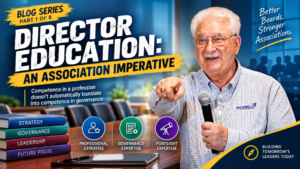
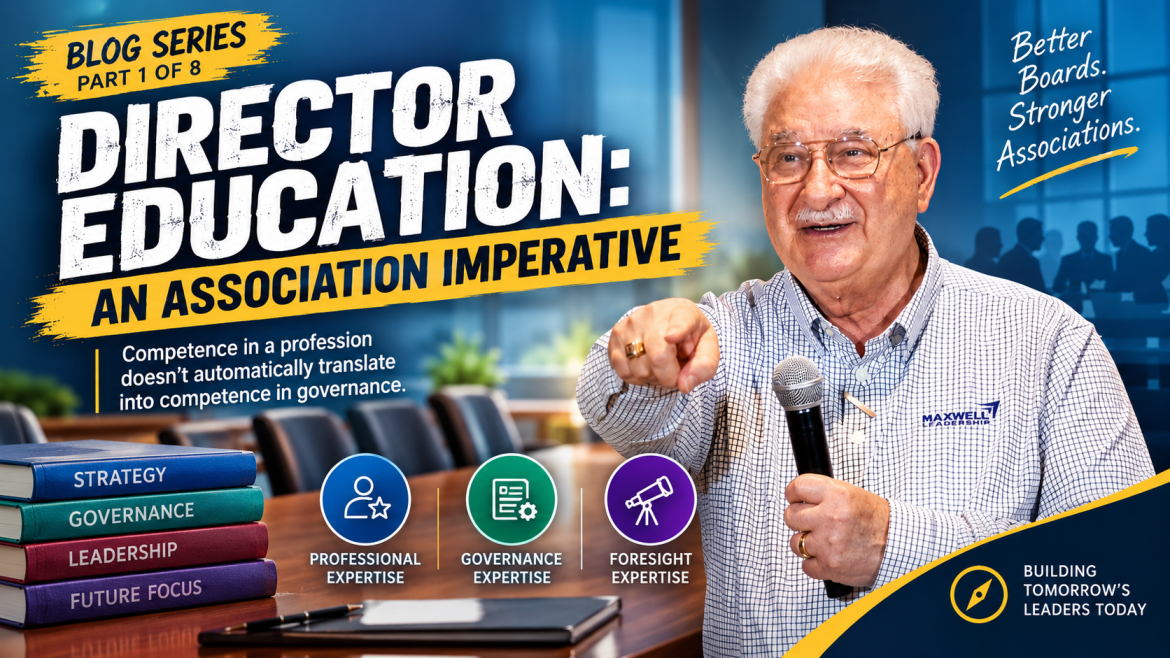
Part 1 of 8 — Director Education: An Association Imperative
A board member spends three days a year reading committee reports, one afternoon at an orientation session, and then sits down to vote on a strategic pivot that will shape the association for a decade. No one in the room asks whether that director has ever been taught how to make that decision. The quiet, almost universal assumption is that competence in a profession transfers automatically into competence in governance. It doesn’t, and every executive who has watched a technically brilliant board flounder on a strategic question already knows it.
Associations spend real money developing the people who work for them: staff training, certifications, leadership pipelines, succession plans—talent development as a core operating function, not a nicety. Then the same organizations hand their most consequential decisions to a rotating group of volunteers who received a binder and a review of the bylaws. Staff development is a line item. Director development is an afterthought, if it exists at all. That asymmetry is strange, because directors, not staff, make the highest-leverage decisions in the organization: whether to enter a new market, sunset a program, change the dues model, or replace the chief executive. Get those decisions right and the association compounds relevance for years. Get them wrong, and no amount of staff excellence compensates.
The floor the law already built
Directors owe their organizations three well-established duties: care, loyalty, and obedience. The duty of care requires directors to make informed, attentive decisions; the duty of loyalty requires them to put the organization’s interests ahead of personal or outside interests; the duty of obedience requires them to act within the organization’s mission and legal boundaries (BoardSource on fiduciary duties). These duties are foundational, and no association should treat them casually. But notice what they were built to do: prevent harm. They exist to catch self-dealing, negligence, and mission drift—the failure modes of a bad or careless board. They say almost nothing about how a board develops the judgment to see a shift in its environment before it becomes a crisis, or the discipline to choose well among several plausible futures. Fiduciary duty is the floor. This series is about everything above it. I won’t revisit the floor in this series — once named, it stays named, and the real work starts here.
Three different jobs wearing one name
Call it “governance experience,” and the term flattens three distinct competencies into one, which is exactly how associations end up recruiting for one skill and expecting three.
The first is professional or subject-matter expertise—the reason most directors get invited onto the board in the first place. A respected clinician, engineer, or business owner brings credibility, a network, an election among only members, and domain fluency. The second is governance expertise: understanding the difference between setting direction and executing it, reading a financial statement for warning signs rather than just approving it, evaluating a chief executive against mission rather than personality. The third is foresight expertise: the capacity to scan weak signals, hold multiple plausible futures at once, and make disciplined bets under real uncertainty rather than default to the comfortable extrapolation of last year’s plan.
Most nominating committees screen hard for the first, assume the second will show up through osmosis, and never mention the third. A director who has spent thirty years running a successful practice or teaching is not automatically equipped to interrogate a five-year revenue model, and a director skilled at both is not automatically equipped to ask what happens to the association’s value proposition if membership itself changes shape. These are learnable skills, not personality traits, which means the absence of training is a choice, not an inevitability.
Why a binder cannot build a competency
Most associations already run something they call board development. In practice, it is orientation: a packet of bylaws, a tour of committee structures, a fiduciary-duty refresher, and a seat assignment. That single event does real work; it transmits information a new director genuinely needs. What it cannot do is build competency, because competencies come through repetition, feedback, and practice under real conditions, not a single exposure to material.
No association would develop a program director this way, hand them a manual on day one, and call their professional development complete for the next three years. It would expect ongoing coaching, feedback on real decisions, and deliberate skill-building over time. Yet that is exactly the model most boards apply to the people making the organization’s biggest bets. A single orientation session might convey what the board does. It cannot teach a director how to ask a generative question under pressure, trace the second-order effects of a dues change, or sit with genuine uncertainty instead of forcing premature closure. Those are practiced skills, and practiced skills decay without reinforcement, which is why a director who was sharp in year one can go quiet and compliant by year three, not because they got worse, but because nothing ever asked more of them.
Directors need director education. Not orientation, not a fiduciary refresher, not a conference sponsorship treated as a training line item; an ongoing, deliberate practice of building the specific capacities governance now demands.
Why the stakes just changed
This gap in director development would matter in any era. It matters more now because the conditions boards are governing through have shifted underneath the models most associations still use. Futurist Jamais Cascio, writing through the Institute for the Future, describes the current operating environment as BANI: brittle, anxious, nonlinear, and incomprehensible, a deliberate successor to the more familiar VUCA framing, built for a world where systems don’t just change unpredictably but can fail outright and where linear cause-and-effect reasoning quietly stops working (Cascio / Institute for the Future). Layer on the generational shift already reshaping membership expectations, participation patterns, and what younger professionals want from a professional community, and the legacy governance model, built for a slower, more linear, more predictable era, starts to show its age.
A board equipped only to comply is a board built for a world that mostly holds still. That world is not the one associations operate in now. Boards need a compass, not a GPS: internal capacities for orienting under uncertainty, because the turn-by-turn directions built for yesterday’s world will not get them where they need to go. That requires disciplined curiosity, comfort with ambiguity, and the ability to govern for what is next rather than audit what already happened.
Where the rest of this series goes
This series builds one argument across eight posts, and each hands the reader a specific, practicable skill. Part 2 tackles the single most common source of board dysfunction: a nonprofit board, structurally, employs exactly one person, and most governance failures trace back to directors forgetting that. Part 3 treats curiosity as a trainable skill: compliance questions versus generative ones. Part 4 brings systems thinking into the boardroom, so directors learn to trace a decision’s second- and third-order effects before they vote. Part 5 builds scenario fluency, treating multiple plausible futures as a working literacy rather than a once-a-decade retreat. Part 6 argues that digital and AI literacy is now a governance competency, not a technical footnote delegated to staff. Part 7 draws on adaptive leadership to help boards tell problems they can delegate apart from challenges that require the board itself to change. Part 8 ties it all into a learning architecture, the concrete system that turns director education from an event into a continuous practice.
A few practices worth starting now
You don’t need to wait for Part 8 to begin. Consider bringing one of these to your next board meeting or planning session:
- Separate “governance readiness” from “subject-matter credibility” explicitly in your next board recruitment cycle, and screen for both.
- Ask your board chair how much was spent on director development last year versus staff development, and put both numbers on the table.
- Replace one item on your next orientation agenda with a short discussion of a real, recent board decision; what assumptions drove it, and what evidence would have changed the outcome.
- Set a recurring calendar item, even quarterly, dedicated purely to building a governance or foresight skill; not reviewing financials, not committee reports.
Where this leaves us
Nothing about this is a condemnation of any single board or director. Most boards are doing exactly what they were trained to do, which is the point. They were never trained to do more. The fiduciary floor keeps organizations out of legal and ethical trouble. It was never meant to prepare a board to lead through a brittle, nonlinear, generationally shifting climate, and pretending otherwise leaves associations governed by people doing their best with tools built for a different era.
So take an honest look at what your board’s education budget actually buys. If it is a bylaws review and a conference sponsorship, ask yourself plainly: what exactly are you preparing your directors to lead?
If you want a clearer picture of where your own board stands, a Future-Ready Board Assessment or a short Strategic Capacity Briefing conversation is a good next step; reach out and let’s look at what your board is actually being prepared, or not prepared, to do.
Sources
- BoardSource, “Legal Responsibilities of Nonprofit Boards”: https://boardsource.org/fundamental-topics-of-nonprofit-board-service/legal-responsibilities/
- Jamais Cascio / Institute for the Future, “Navigating the Age of Chaos: A Sense-Making Guide to a BANI World That Doesn’t Make Sense”: https://www.iftf.org/insights/navigating-the-age-of-chaos-a-sense-making-guide-to-a-bani-world-that-doesnt-make-sense/