
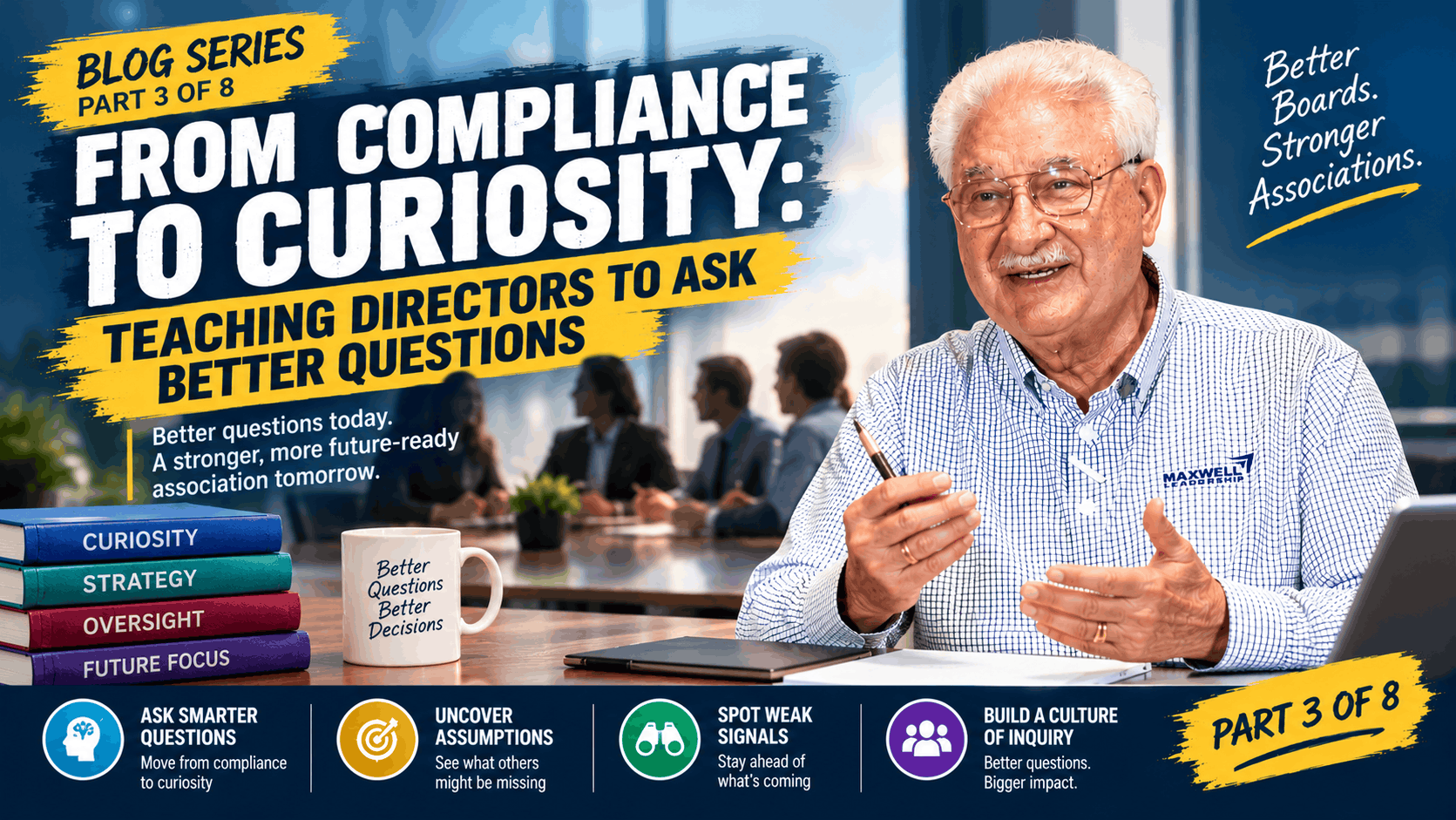
Part 3 of 8 — Director Education: An Association Imperative
A board is about to vote on a new membership tier. Someone asks whether the pricing fits the budget. Someone else asks whether legal has reviewed the language. A third director asks if this matches what the last member survey said people wanted. Every question is reasonable. Every question gets answered. And the board votes yes, twelve minutes after the item hit the table, without ever asking what has to be true about the next five years for this tier actually to work. That board didn’t fail its fiduciary duty—it read the numbers, checked the policy, and stayed inside its authority. But meeting that floor and doing the job are not the same thing. The job includes seeing around the corner before this decision takes us there. Boards don’t gain that foresight from a retreat, a consultant, or a fancier dashboard. They gain it by asking a better question at the table before the vote—and most boards have never learned how to ask one.
Compliance Questions Protect the Past. Generative Questions Protect the Future.
Every board asks compliance questions, and every board should. Did we follow the policy? Are we within budget? Does this expose us to liability? These questions look backward and inward. They confirm that what already happened happened correctly. An association that stops asking them is asking for trouble.
But a board that asks only these questions is steering by the rearview mirror. It can tell you with precision where the organization has been. It can’t tell you where the organization is headed, because it never asks the questions that face forward: What might be true in five years that isn’t true today? What are we assuming here that we haven’t actually tested? What would have to be true for this plan to fail?
Call the first category compliance questions and the second generative questions. Compliance questions confirm; generative questions unsettle. Compliance questions have a right answer sitting in a policy manual; generative questions open a conversation nobody in the room can finish alone. A board fluent only in the first kind will always be well-behaved and frequently blindsided. Foresight- real, working foresight, not the kind that shows up once a year in a strategic-planning deck- lives in the second kind, asked routinely, in ordinary meetings, about ordinary items.
These questions are the argument at the center of this post: disciplined curiosity isn’t a personality trait some directors happen to have, and others lack. It’s a skill, and skills can be taught.
Curiosity Is a Skill. Treat It Like One.
Boards tend to sort their members informally into “the ones who ask good questions” and “the ones who don’t say much.” That sorting quietly tells directors that inquiry is a fixed trait; you either have the knack, or you don’t, which lets everyone off the hook. The quiet directors stay quiet. The association never builds capacity because it never treated capacity as buildable.
Reframe it. Asking a sharp, forward-looking question in a boardroom is a specific, learnable behavior, closer to a golf swing than to a gift. It has parts. A director can practice:
- Surfacing unstated assumptions before a vote. Every proposal rests on a handful of beliefs nobody said out loud; that renewal rates will hold, that the vendor will scale, that members want what staff thinks they want. A trained director learns to ask, plainly, “what are we assuming here that we haven’t actually checked?”
- Distinguishing symptoms from root conditions. When staff brings the board a problem, the problem as presented is almost always a symptom. Declining conference attendance is a symptom; the root condition might be a membership model built for a workforce that no longer exists. A trained director learns to ask “what is this a symptom of?” before reaching for a fix.
- Scanning weak signals instead of waiting for lagging indicators. By the time revenue drops, the association is reading a story that finished writing itself two years earlier. A trained director learns to ask what’s shifting at the edges right now: in membership composition, in competitor behavior, in adjacent industries and associations, long before it shows up in a year-end statement.
None of this requires special expertise. It requires practice, repetition, and an association willing to say out loud that this is part of a director’s job description, not an extra-credit assignment for the naturally inquisitive.
An Illustrative Case: The Vote That Skipped the Question
Consider a composite that will feel familiar to most association leaders, drawn from the pattern rather than any single client. A mid-sized professional association’s board reviews a staff recommendation to sunset an in-person regional event series and reinvest the budget into a national virtual conference. The numbers look clean: the regional series has lost money three years running, the virtual conference has strong early registration data, and staff has clearly done its homework. The board asks whether the budget math holds up, whether staff has vendor contracts under control, and whether this creates any legal exposure with existing sponsor agreements. Satisfied, it approves the shift in under fifteen minutes.
Eighteen months later, membership renewal in the association’s early-career segment has softened noticeably. The regional events, it turns out, were where early-career members met each other, found mentors, and felt like they belonged to something local; value the survey data never captured because nobody asked about it directly, and value a national virtual conference structurally cannot replace.
One generative question, asked before the vote, would likely have surfaced this: What are we assuming about why members valued the regional series, and have we tested it, or just inferred it from a budget line? That question doesn’t kill the decision to sunset the series. It might not even change the outcome. But it forces the assumption into the open where the board can weigh it, instead of discovering it as an unpleasant surprise a year and a half later.
Building the Habit: A Curriculum, Not a Lecture
Telling directors to “ask better questions” once in an orientation session changes nothing. Like any trained skill, disciplined inquiry decays without reinforcement; a board that hears this message once a year and practices it never will drift straight back to compliance-only questioning, because compliance questions are easier, faster, and feel safer to ask out loud. Building the habit takes structure, repeated often enough to become normal rather than notable. Two practices, used together, do real work:
- A rotating board question bank. Before each meeting, every director contributes one generative question relevant to the agenda; not a comment, a question. The board keeps a running bank of these, and any director can draw from it during discussion. Over time, the bank becomes a shared library of the association’s best forward-looking thinking, and contributing to it becomes a normal, expected act of governance rather than a performance.
- A standing five-minute “what are we assuming?” segment before any major vote. Not a full discussion, five minutes, deliberately timeboxed, where the chair asks the room to name the assumptions embedded in the proposal on the table. Some meetings this surfaces nothing new. Often it surfaces the one thing nobody had said aloud yet.
Neither practice requires a facilitator, a retreat, or a budget line. Both require a chair and a chief executive willing to protect five minutes of agenda time against the perennial pressure to move faster, which signals what the board actually values.
Where This Leaves Us
Most directors reach the boardroom having never once been coached on how to ask a good question there. Directors have been coached on their profession, their industry, maybe on public speaking, never specifically on the discipline of inquiry that governance actually requires. That’s not a character flaw in your board. It’s a gap in your board’s education, and gaps in education close only through deliberate teaching and repeated practice, not through hoping the naturally curious directors carry the room.
A board fluent in compliance questions will always know what already happened. A board that also builds fluency in generative questions gives itself a chance to notice what’s coming before it arrives; to govern for what is next, not just account for what already passed. That shift doesn’t require a scenario-planning retreat or an outside consultant standing at a whiteboard. It requires one better question, asked out loud, at your next meeting.
So bring one. Before your board’s next major vote, ask it: what are we assuming here that we haven’t tested? Then watch what happens to the conversation in the room, and ask yourself whether that’s the conversation your board has been having all along.
If you want a clearer picture of where your board currently sits on this spectrum, a Future-Ready Board Assessment will show you, concretely, whether your meetings run on compliance questions alone or on both. A short Strategic Capacity Briefing conversation can help you design the specific practice, like a question bank or an assumptions segment, that fits your board’s actual rhythm.
Let me know what you think. Next week, Part 4 of 8: Systems Thinking for the Boardroom: Seeing the Second- and Third-Order Effects