Part 2 of 8 — Director Education: An Association Imperative
Picture the moment in almost any board meeting: a director who has spent thirty years running clinics, managing operations, or classrooms leans into a program update and starts redlining the tactics instead of asking whether the program serves the mission; redlining the tactics, the vendor choice, the staffing ratio, the marketing copy. Everyone in the room feels the meeting tilt. The staff person presenting goes quiet or defensive. The board chair lets it run because stopping it feels awkward. Nobody names what just happened, but something did: a director just did someone else’s job, and the Board’s actual job sat untouched on the table.
That moment is not a personality problem. It is a structural one, and it is the single most common failure mode in association governance.
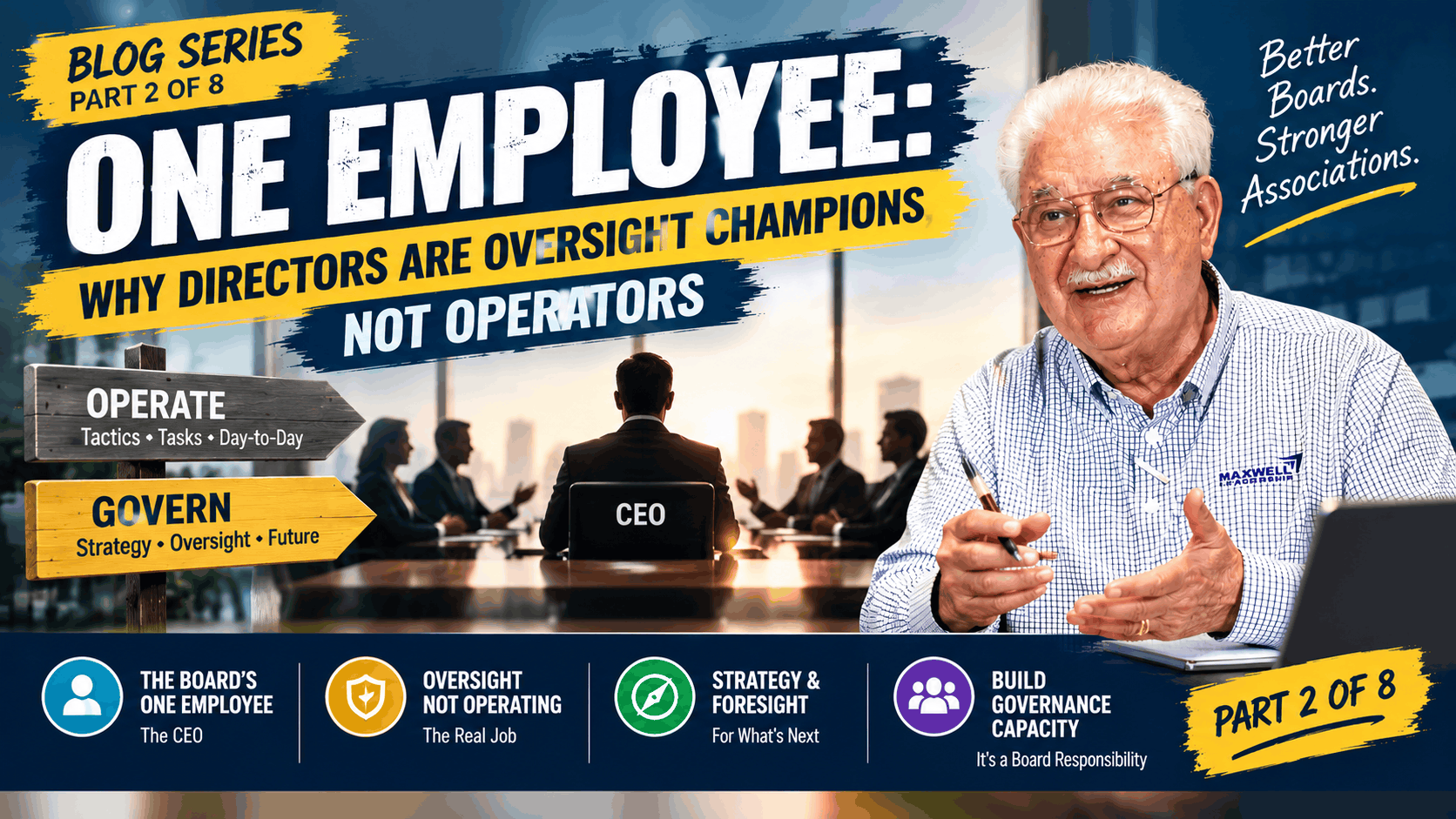
The Board employs one person.
Here is the plain fact most boards never say out loud: a nonprofit or association board, in practice, employs exactly one person—the chief executive. Everyone else on staff works for that person, not for the Board, and not for any individual director, however senior or well-credentialed. Every staff relationship a director might want to have runs through the CEO’s employment relationship with the Board. None of it runs around it. None of it runs parallel to it.
The Board’s one employee only is not a technicality buried in a bylaws appendix. It is the architecture of the entire governance system. Once you see it, you cannot look at a board meeting the same way again: who evaluates whom, who sets direction versus who executes it, what “chain of command” actually means at the top of the organization. The Board evaluates the CEO. Full stop. The CEO manages, evaluates, and directs everyone else. The Board does not have a dotted-line relationship with a Deputy Executive, VP of programs, the membership director, or the meetings team, no matter how many task forces put a director in the same room as that staff person. A director’s role in that room is oversight and partnership with the CEO; not a supervisory relationship with anyone the CEO employs.
This single-employee model is the load-bearing wall of nonprofit governance. Most board dysfunction, when you trace it far enough back, is a director leaning on that wall.
Why capable people keep crossing the line
The directors who cross this line are seldom careless. They are usually the opposite: deeply expert in their profession, genuinely invested in the association’s success, and accustomed to being the smartest person in a room about their subject matter. That expertise is exactly what seduces them into operating instead of governing.
Subject-matter expertise feels like permission. If you spent a career building marketing funnels, a marketing dashboard is legible to you in a way that “evaluate the CEO’s future-readiness” is not. Operational work is concrete; you can point to a decision, a metric, a fix. Governance and foresight work is ambiguous, slower, and harder to feel finished. So a director who wants to be useful, and who is sitting in a meeting that already feels abstract, reaches for what feels productive. Redlining the tactics feels like contribution. Asking “what will membership look like in a decade if this trend continues?” feels like conversation.
There is also a comfort dimension. Governance asks directors to sit with uncertainty; to hold a compass, not GPS, and navigate direction without a guaranteed route. Operating asks nothing of the kind. It offers a clear task and a visible outcome. Under the pressure of a two-hour meeting, most people will choose the clear task over the ambiguous compass every time, even when they know, structurally, that it isn’t their job.
What it actually costs
The cost isn’t abstract, and it isn’t limited to an awkward ten minutes. Every time a board operates instead of governs, two things happen simultaneously.
First, it quietly de-authorizes the CEO. Staff notice when a board member overrides, second-guesses, or works around the chief executive on operational matters. It does not take many instances before staff start treating the CEO as one voice among several rather than the person running the organization, and before the CEO starts managing around the Board instead of with it. That is not a hypothetical risk; it is how executive turnover and staff attrition quietly begin.
Second, it crowds out the work only the Board can do. A board meeting has finite time and finite attention. Every minute spent on program tactics is a minute not spent on the two things a board actually exists to provide: oversight of the CEO against mission and future-readiness, and Foresight about where the association needs to be in three, five, ten years. Boards that spend their meetings operating are, by definition, not governing for what is next.
Illustrative scenario: Imagine a mid-sized professional association whose Board includes several practicing members of the profession itself; clinicians, engineers, educators, whatever the field. At every meeting, at least one director wants to weigh in on continuing-education content, credentialing criteria, or a conference agenda, because they know that material cold. The CEO, an experienced association executive without a clinical background, starts pre-negotiating program decisions with individual directors before meetings to avoid public relitigating. Over eighteen months, the Board never once discusses membership erosion among younger professionals, a trend the CEO has flagged twice in written reports. The Board is busy. It is also, in the way that matters, absent.
Reframing oversight as the real job
None of this means directors should disengage or stop caring about program quality. It means channeling that care into the form only a board can deliver.
Oversight, done well, is not passive and it is not distant. It means evaluating the CEO against mission and future-readiness rather than task completion; not “did the conference happen” but “is this organization more relevant to its members than it was a year ago, and is it positioned for what’s coming.” It means holding a strategic, foresight-focused partnership with the CEO: asking hard, forward-looking questions, pressure-testing assumptions, and using disciplined curiosity to surface what the organization isn’t yet seeing. It means protecting long-term relevance, a job no one else in the organization is positioned or authorized to do. That is stewardship in its most literal sense; holding something in trust for a future the Board will not fully see.
Oversight and Foresight are harder than operating. It is also the only version of the job the Board actually holds.
The Board’s responsibility for itself
Once a board recognizes this line, it may be tempted to hand the fix to the CEO: tell us when we’re overstepping, coach us out of it, keep us in our lane. That temptation deserves a direct answer.
The Board is responsible for itself and its learning.
The CEO can supply materials, briefings, dashboards, and well-designed meeting agendas that create the conditions for good governance. A skilled CEO will do exactly that. But the CEO cannot substitute for the Board’s own responsibility to learn how to be a board. If directors only govern well when the CEO manages them into it, the Board has not built governance capacity—it has built a dependency, and a fragile one. Learning the difference between oversight and operating is the Board’s job, not the CEO’s job to engineer around.
A short self-audit
Before your next board meeting fades from memory, ask yourself three questions about the last one:
- In the last meeting, did I ask a question about direction, risk, or the CEO’s judgment — or did I ask a question about a task, a vendor, or a staff decision?
- Did I spend more time evaluating whether the organization is future-ready than evaluating whether a specific deliverable is done well?
- If a staff member had been in the room instead of the CEO, would my comment have landed as governance, or as a performance review I had no authority to give?
If most of your honest answers land on the second half of each question, you were operating. Name that to yourself before it becomes a pattern the whole Board absorbs.
Where this leaves us
No director crosses this line out of bad faith. They cross it because operating is legible and governing is not, because expertise is a comfortable place to stand, and because ambiguity is uncomfortable even for accomplished people. Naming the single-employee model does not make the discomfort disappear. It just makes the choice visible every time you are tempted to reach for the concrete task instead of the harder question.
So look back honestly at your last board meeting. When you spoke, were you governing the organization, or were you, without quite meaning to, running it?
If you’re not sure, that uncertainty is worth more than a guess. Bring one of the three self-audit questions above to your next board meeting and ask your fellow directors to answer it out loud with you or, if you want a fuller picture of where your Board sits on the oversight-versus-operating line, book a Future-Ready Board Assessment conversation and let’s map it together before it hardens into habit.
Let me know what you think. Next week: Part 3-From Compliance to Curiosity: Teaching Directors to Ask Better Questions