
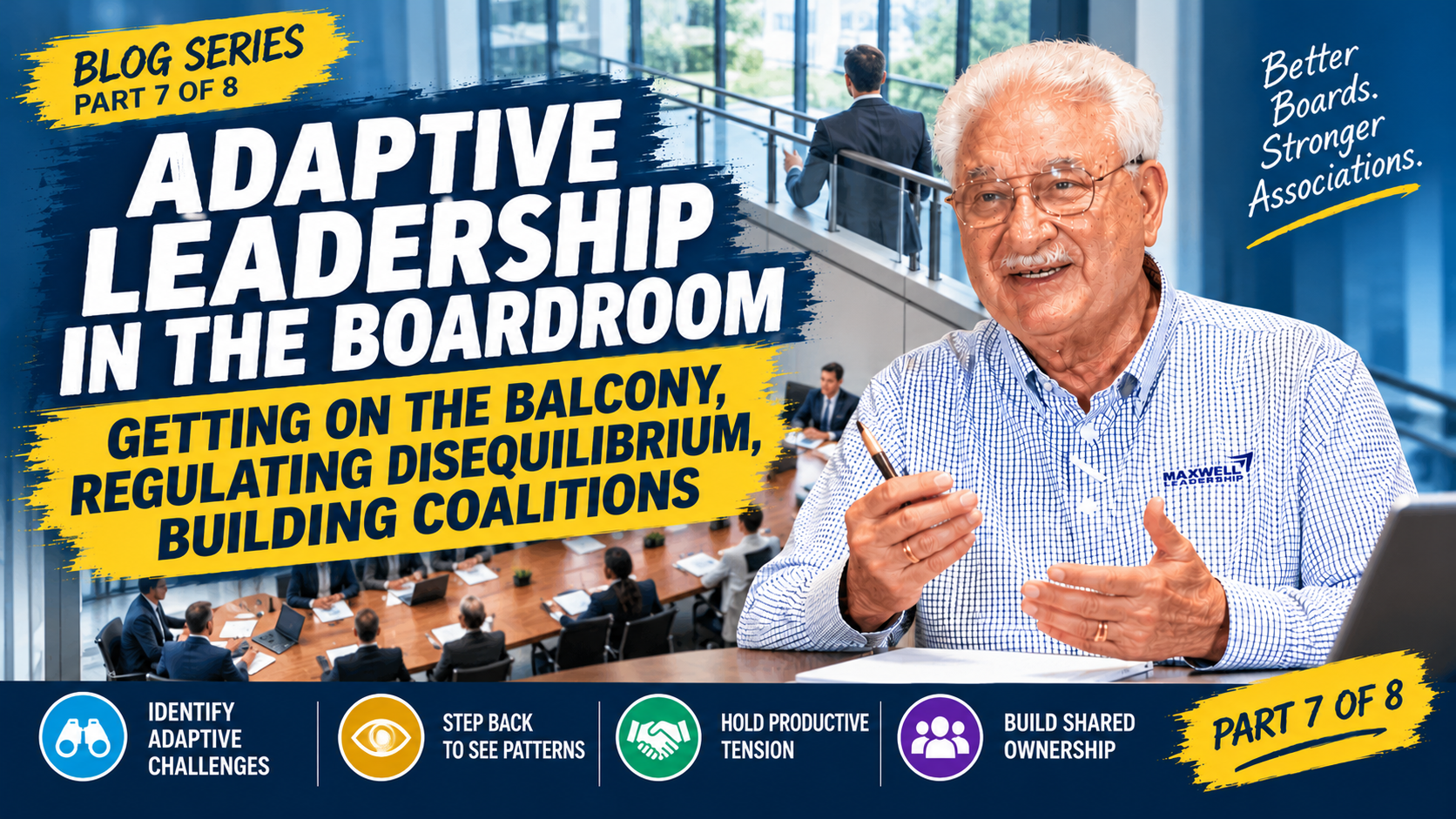
Part 7 of 8 — Director Education: An Association Imperative
Watch a board wrestle with a hard issue for two meetings running, then watch it resolve the discomfort by voting on something that changes almost nothing. That pattern is not a failure of intelligence or goodwill. It is a board treating an adaptive challenge as if it were a technical one, and directors rarely notice the substitution happening.
Adaptive leadership, as Ronald Heifetz, Alexander Grashow, and Marty Linsky develop it in The Practice of Adaptive Leadership, names that pattern and gives it a remedy. Most teaching drawn from their work targets individual leaders: the executive, the founder, the person with the title. Boards need the same discipline, but cannot practice it as individuals. A board practices adaptive leadership collectively, or not at all.
Technical Problems Get Solved. Adaptive Challenges Get Owned.
Heifetz and his colleagues distinguish that governance conversations skip past too quickly. Technical problems have known solutions, and the people in authority already have the expertise to apply them: a compliance filing, a budget variance, a policy update. Responsibility for solving a technical problem can stay with whoever is in charge; the fix does not require anyone to change how they think (Heifetz, Grashow & Linsky, reviewed in the Journal of Applied Christian Leadership).
Adaptive challenges have no such answer sitting in reserve. They require the people living inside the problem, not just the people with authority, to change habits, values, roles, or assumptions. Responsibility cannot stay with a single leader; it has to transfer to the people who need to do the learning (Heifetz, Grashow & Linsky). A declining membership pipeline is rarely a marketing problem. A credentialing program losing relevance to a changing profession is rarely a curriculum problem. A board that can’t agree on what business it’s actually in is never a bylaws problem. Each is adaptive at its core, and each gets treated as technical all the time because technical problems are more comfortable. You can delegate a technical problem. You cannot delegate an adaptive one; you can only avoid it by pretending it’s technical.
That avoidance has a shape: refer the issue to a committee, hire a consultant to “fix” it, commission a study. Each move looks like diligence. Often it’s a way to make the discomfort of an unresolved adaptive challenge disappear without changing what the board itself believes or how it behaves.
The Illustrative Case: A Membership Model Everyone Knew Was Broken
Picture a mid-sized professional association —a composite, not any real organization—whose membership had flattened for six straight years while the underlying profession kept growing. Every board conversation about it followed the same script: assign it to the membership committee, ask staff to benchmark competitor dues structures, revisit in Q3. Three consecutive committee reports proposed a tiered pricing model. The board adopted each one. Membership kept flattening.
The real issue was never pricing. Younger professionals no longer organized their careers around one national association; they built identity through smaller, faster-moving communities and treated national membership as optional overhead. Reversing that meant abandoning a long-held assumption that the value proposition was self-evidently obvious and needed only better packaging for harder, more exposed questions about relevance, unbundling services, and possibly cannibalizing the association’s own revenue model. That conversation required the board to change its own thinking, not its pricing sheet. Treating a relevance crisis as a pricing exercise let the board feel productive while the actual challenge went unaddressed for years.
Getting on the Balcony: A Practice Boards Rarely Do on Purpose
Heifetz’s most durable image names the two places a leader can stand. The dancefloor is where the action happens: the debate, the disagreement, the maneuvering in real time. The balcony is the vantage point above it, the place from which patterns become visible that are invisible from inside the dance (The Right Questions, “How to Lead from the Dancefloor and Balcony”). From the balcony, a leader or in this case, a board can see value conflicts, power struggles, patterns of work avoidance, and dysfunctional habits that no one notices while they’re busy dancing (Heifetz, Grashow & Linsky).
Boards rarely do this deliberately. A board meeting is the dance floor by design: an agenda, motions, votes, a clock. Nothing on a standard agenda asks the board to observe its own patterns: Why does this same argument resurface every year in different words? Why does the finance chair’s caution always overpower the emerging-issues discussion? Why does dissent from one director read as disloyalty while identical dissent from another reads as insight? A board that never gets on the balcony keeps re-fighting the same fight and calling it a new agenda item.
Getting on the balcony is not a retreat activity that happens once a year. It’s a discipline, a standing practice of pausing mid-debate to ask what pattern this argument belongs to, then returning to the dancefloor with that pattern named out loud. This practice is disciplined curiosity applied to the board’s own behavior, not just to the organization’s environment.
Regulating Disequilibrium: The Discipline of Not Resolving Discomfort Too Soon
Adaptive work generates real distress, and a board’s instinct is almost always to make the distress stop, usually by calling the question and voting. That instinct is understandable and almost always premature. If the room settles before the actual tension gets named, the board has manufactured the appearance of resolution without doing the adaptive work underneath it.
The opposite failure is just as common: tension that never gets regulated at all curdles into something personal. Disagreement about strategy becomes a grudge between two directors. A values conflict becomes a permanent faction. A board that cannot tell the difference between productive disequilibrium and dysfunction will eventually default to whichever director shouts loudest or whichever chair moves fastest to shut down the conversation.
Holding a board through productive tension —long enough for real learning to happen, but not so long that the room fractures—is a pacing skill. It has almost nothing to do with parliamentary procedure and almost everything to do with a chair, and a full board, willing to sit with an unresolved question past the point of comfort.
Building Coalitions: Why This Cannot Be One Person’s Job
An association board is not a team assembled around shared training; it’s a coalition of volunteers who each arrive with a different professional lens, a different risk tolerance, and a different set of unexamined assumptions about what the organization is for. A retired executive director, a solo practitioner three years into the field, and a corporate general counsel do not read the same balance sheet the same way, and they will not read an adaptive challenge the same way either.
That’s precisely why adaptive leadership at the board level cannot be delegated to the chair or handed off to the CEO. A CEO who tries to force an adaptive resolution alone will get resistance dressed up as procedural objection. A chair who tries to shortcut consensus will get compliance without ownership. The work has to move through the board as a body: building enough shared understanding across those different lenses that the eventual shift in values or habits belongs to the board collectively, not to whoever pushed hardest for it.
A Short Self-Assessment: Is This Issue Technical or Adaptive?
Before the board’s next difficult agenda item, ask:
- Does a known, expert-applied fix already exist, or are we hoping one will emerge from a committee we haven’t yet empowered to change anything fundamental?
- Would solving this require any director, including us, to give up an assumption we currently hold as obvious?
- Have we assigned this to staff or a consultant specifically to avoid a conversation the full board doesn’t want to have?
- Are we more uncomfortable with the problem or with sitting in the discomfort of not yet knowing the answer?
- If we “solved” this the way we’re currently planning to, would the underlying pattern still be there in three years?
If the honest answers land on “us,” this is adaptive, and no committee will resolve it for you.
Where This Leaves Us
You cannot delegate your way out of an adaptive challenge, and you cannot vote your way past disequilibrium that hasn’t finished doing its work. Adaptive leadership at the board level is not a technique the chair performs while everyone else watches; it’s a shared discipline the whole board either builds or lacks. Getting on the balcony, holding productive tension, and building coalition across genuinely different professional lenses are all learnable, but only if the board decides its hardest problem deserves that kind of attention instead of another committee referral.
So take an honest look at whatever issue has occupied your board’s last three meetings without resolution. Is it sitting on that list because no one has found the right technical fix yet, or because the fix would require your board to change, and some part of the room already senses that and would rather not?
If you want a structured way to find out, a Future-Ready Board Assessment or a Strategic Capacity Briefing conversation can help your board diagnose, in the next 90 days, which of its current issues are genuinely adaptive and give your directors a shared vocabulary for working through them instead of routing around them.
Let me know what you think. Next week, Part 8-Building the Learning Architecture: From Orientation to Continuous Director Education
Sources
“How to Lead from the Dancefloor and Balcony (Adaptive Leadership),” The Right Questions
Heifetz, R., Grashow, A., & Linsky, M., The Practice of Adaptive Leadership: Tools and Tactics for Changing Your Organization and the World — reviewed in the Journal of Applied Christian Leadership