
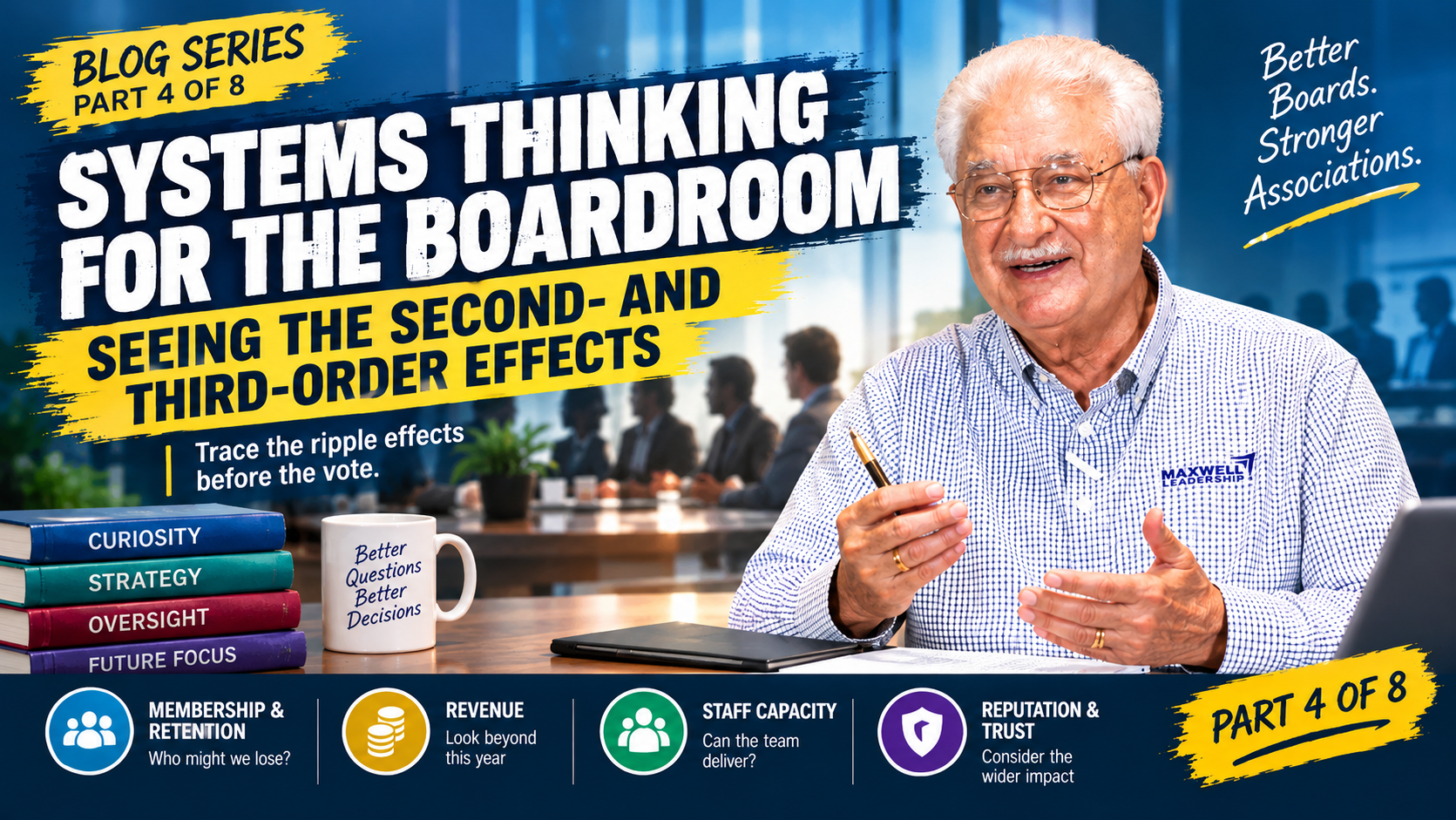
Part 4 of 8 — Director Education: An Association Imperative
The finance chair has just walked the board through a dues increase; modest, defensible, and tied cleanly to a projected budget gap. The spreadsheet closes the hole. Nobody has raised their hand to object. The chair calls the question, and eighteen minutes later the board moves to the next agenda item, satisfied that it has done its job.
It has done a job. Just not the whole one. What that board evaluated was the first-order effect of the decision: does this balance the budget? — and nothing else. It did not ask what a three percent increase does to renewal rates among members already weighing whether the association still earns their loyalty. It did not ask what a dip in renewals does to staff capacity six months later, when program managers were asked to do more with a smaller team. It did not ask what a thinner program slate does to the association’s reputation with the very members the increase was supposed to retain. The vote was clean. The consequences were not confined to the ledger line the board was looking at.
This is the gap director education rarely closes: most directors know how to evaluate a decision. Few are taught to trace where it goes after the vote. That dues increase satisfied every duty a director owes- care, loyalty, obedience- because fiduciary duty was built to catch self-dealing and negligence, not to ask where a financially sound decision quietly goes after the gavel falls.
What Senge understood that boardrooms still resist
Peter Senge’s The Fifth Discipline made an argument that has aged into common sense in operations and strategy circles but has barely reached governance: organizations behave as systems, not as collections of independent decisions, and the parts of a system are connected by feedback loops that carry consequences far past the point where anyone was looking (Senge, The Fifth Discipline). A change in one part of the system doesn’t stay there. It moves, sometimes slowly, sometimes with a lag long enough that nobody connects the dots back to the original decision. Senge’s core insight for a boardroom translates: today’s problem was often yesterday’s solution, working exactly as designed, just further downstream than anyone tracked it.
Boards don’t need Senge’s full apparatus of stocks, flows, and causal loop diagrams to use this. They need the discipline it implies before you vote: ask what this decision touches beyond the line item in front of you.
Feedback loops, unintended consequences, and the symptom trap
Strip the jargon down to boardroom language and three ideas do most of the work.
A feedback loop is simply a consequence that circles back and changes the conditions of the original decision. Raise dues, lose marginal members, collect less net revenue than projected, and now the board faces the same budget pressure it thought it had solved, except with a smaller, more price-sensitive membership base than before. The loop closed on itself.
An unintended consequence is a real effect the board didn’t evaluate because it wasn’t the effect the board was solving for. Nobody voted to shrink program capacity. The board voted to close a budget gap, and reduced program capacity showed up later as a side effect of the retention drop nobody modeled.
Boards most often blur the distinction between a problem and a symptom. A budget shortfall is usually a symptom. The problem underneath it might be stagnant value perception among a specific member segment, a pricing model built for a membership base that no longer exists, or a program portfolio that hasn’t been pruned in a decade. Raise dues to fix the symptom, and the problem- declining perceived value- keeps generating the same shortfall next year, at a higher price point, with fewer people willing to pay it.
A practical tool: the four-dimension ripple check
Boards don’t need a systems-dynamics degree to build this discipline into a normal meeting. They need a habit: before any major vote, spend fifteen minutes tracing the decision’s likely second- and third-order effects across four dimensions.
- Membership and retention. Who is most likely to leave, downgrade, or disengage because of this decision, and which segment can the association least afford to lose?
- Revenue. Beyond the immediate budget line, what does this do to renewal revenue, non-dues revenue, or sponsor confidence twelve to twenty-four months out?
- Staff capacity. If this decision changes revenue or membership, what does it do to the workload, tools, or headcount staff has to deliver the mission, and where does that strain surface first?
- Reputation and trust. What does this decision signal the association’s priorities to the members, partners, and prospective members watching how it behaves under pressure?
This exercise doesn’t require certainty. It requires the board to name its assumptions out loud, in the room, before the vote, not discover them in a post-mortem eight months later.
The case that looked simple until it wasn’t
Consider a composite, familiar to almost anyone who has sat on an association board: a legacy certification exam program that has run at a loss for three years. Sunsetting it clears a real deficit, frees staff time, and lets the association redirect resources toward newer offerings. In isolation, the vote looks like disciplined stewardship; cutting what no longer pays for itself.
Traced across four dimensions, the picture gets more complicated. Membership: a meaningful share of the association’s most tenured, most engaged members hold that legacy credential and treat it as core to their professional identity; cutting it reads to them as the association abandoning its own history. Revenue: some of those members were also the association’s most reliable annual-conference attendees and donors, and their disengagement shows up as softness in categories nobody connected to the program decision. Staff capacity: the freed time gets absorbed almost immediately by a wave of member-service complaints and one-on-one retention calls nobody budgeted for. Reputation: competitor associations and adjacent credentialing bodies quietly position themselves as the more stable, tradition-respecting option for exactly the members the association just alienated. None of that shows up in the financial model that justified the sunset. All of it shows up in the eighteen months that follow the vote.
Reframing due diligence: from the ledger to the whole system
This is the real shift Part 4 asks boards to make. Due diligence has traditionally meant financial and legal review: is this decision solvent, compliant, and free of liability exposure? That review still matters and should never be skipped. But it answers a narrower question than the one the board actually needs answered. Systemic due diligence asks how a decision moves through the whole organization: through the people who rely on it, the staff who deliver around it, and the reputation the association spends years building and can lose in a single budget cycle. A board that only checks the ledger has done half its job and mistaken it for the whole.
Where this leaves us
No board can trace every consequence of every vote; that standard would produce paralysis, not stewardship. But there is a real difference between a board that spends fifteen minutes naming its assumptions across membership, revenue, staff capacity, and reputation before it votes, and a board that discovers those consequences in the next fiscal year’s numbers. One is disciplined foresight. The other is hindsight dressed up as an explanation.
A one-page ripple map, kept in front of the board before any major vote, can close most of that gap. It doesn’t need to be more sophisticated than four questions: Who is most affected by this beyond the immediate topic? What does this change about revenue in the next two years, not just this year? What does this ask of staff that they aren’t already resourced to deliver? What does this signal to the members and partners watching how we handle it? Answer those honestly, on the record, before the gavel falls, not after.
So, ask it plainly of your own board’s last major decision: did you trace its ripple effects before you voted, or only after you saw them?
If your board wants a structured way to build this habit starting with a Future-Ready Board Assessment or a Strategic Capacity Briefing conversation, that’s exactly the work I do with boards preparing to govern for what is next, not just for what’s in front of them this quarter.
Let me know what you think. Next week, part 5: Scenario Fluency: Preparing Directors to Govern Multiple Futures
Sources
- Peter Senge, The Fifth Discipline — https://en.wikipedia.org/wiki/The_Fifth_Discipline