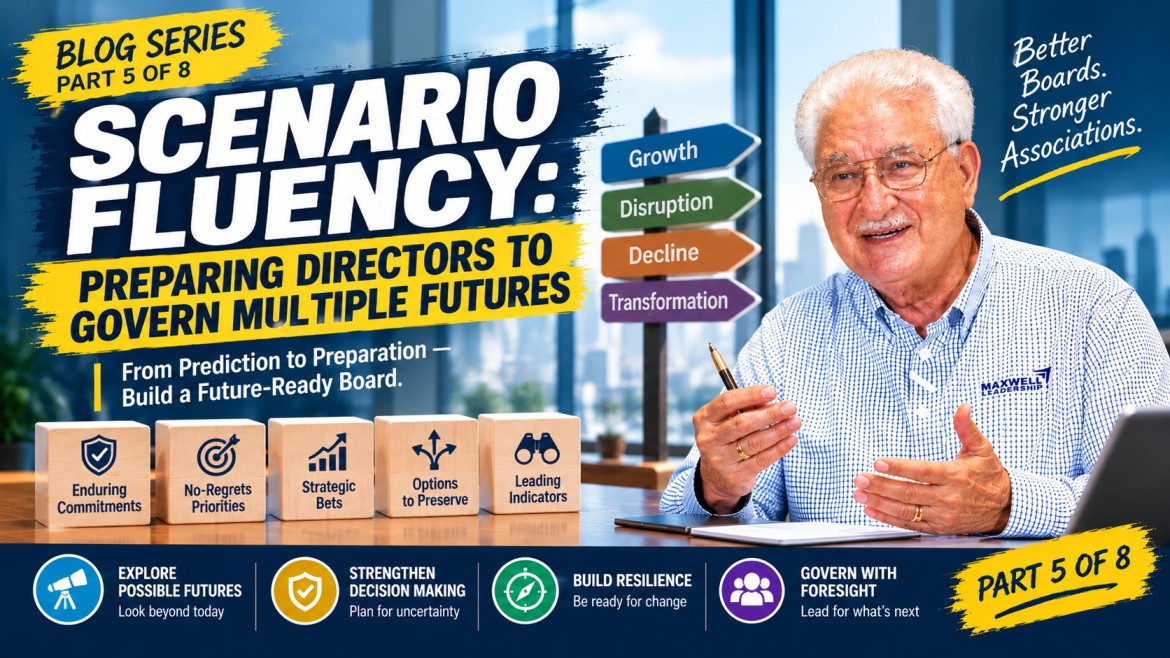
Part 5 of 8 — Director Education: An Association Imperative
A board retreat just ended. The facilitator packs up the sticky notes, the four beautifully named scenarios go into a slide deck, and everyone drives home feeling like the board just did something serious about the future. Eighteen months later, nobody can find the deck. The board is back to voting on strategic bets the same way it always did: one forecast, one gut check, one vote. The retreat happened. The capacity never did.
This post is about that gap. Scenario planning, done as an event, produces a document. Scenario fluency, built as a literacy, changes how a board thinks every time it faces a real decision. Associations need the second far more than the first, and most are investing exclusively in the first.
The Event Trap
Nothing is wrong with a facilitated scenario workshop. A well-run one can sharpen a board’s thinking for months. The trouble starts when the workshop becomes the whole strategy. When “we did scenario planning” means a single retreat that produced a report, rather than a habit of mind the board carries into ordinary business.
Directors don’t need to design four-quadrant futures frameworks or run structured foresight exercises personally. That’s specialized work, and outsourcing the mechanics to a skilled facilitator is reasonable. What directors do need is the underlying literacy: the reflex to ask, before approving any major initiative, “which futures does this bet assume, and does it survive if we’re wrong?” That reflex has to show up in a routine budget vote, not just in a once-a-decade retreat with a rented conference room and a mission statement redesigned on foam board.
Some member-based organizations, including cultural and professional societies and museum associations, have run structured “what if” futures exercises to stress-test their assumptions about attendance, funding, and public trust. The value of that work was never the workshop itself; it was whatever discipline survived the workshop and made it into the next twelve ordinary board decisions. That’s the transfer most boards fail to make.
Preparation, Not Prediction
Here is the sharper reframe underneath scenario fluency: the point was never to guess the future correctly. Single-point forecasts feel authoritative and are almost always wrong in some material way; membership models, funding environments, and technology landscapes shift too fast for any one prediction to hold for long. A board that governs off one forecast is betting on being right, and most boards are not in the business of making that bet with an association’s mission.
Scenario fluency asks a different question. Instead of “what will happen,” it asks “what could plausibly happen, and are we ready regardless of which one arrives?” That shift, from prediction to preparation, is the whole discipline in one sentence. A board doesn’t need a crystal ball. It needs a compass, not a GPS: something that orients decisions across a range of terrain, not a route that works only if the map matches reality exactly.
A Decision Vocabulary Every Director Should Own
Most directors have never been given the language to talk about uncertainty with precision. They default to optimism or caution, without a shared vocabulary for the different kinds of bets a board makes. Five terms cover nearly everything a board needs.
Enduring commitments are the things the board holds across every plausible future, almost always tied directly to mission, and rarely revisited. A professional association’s commitment to protecting the integrity of its credential holds whether membership grows, shrinks, or fragments. These aren’t strategic choices up for debate each year; they’re the fixed points everything else gets measured against.
No-regrets priorities are moves worth making regardless of which future unfolds, because they pay off broadly. Investing in cleaner member data, for instance, helps a board whether the future brings a wave of younger members demanding digital-first engagement or a contraction that forces the association to serve fewer members more precisely. No-regrets moves are usually underfunded because they don’t feel urgent in any single scenario; they’re valuable in all of them, which paradoxically makes them easy to defer.
Strategic bets are the higher-risk, higher-reward moves a board makes deliberately, with documented assumptions about which future has to arrive for the bet to pay off. Launching a new credentialing program is a strategic bet. It can be the right call, but only if the board has written down what must be true about the market, the competitive landscape, and member appetite for the bet to work, rather than approving it on enthusiasm alone.
Options to preserve are capacities or paths the board deliberately keeps open rather than forecloses, in case conditions shift. Choosing a flexible technology contract over a cheaper long-term lock-in preserves options. It costs a little more certainty today in exchange for room to maneuver later, and a board that never thinks in these terms tends to foreclose options accidentally, simply by defaulting to whatever looks most efficient in the moment.
Leading indicators are the early signals a board watches to know which future is emerging, so it isn’t blindsided when the shift is already underway. A drop in early-career membership renewals, a change in employer tuition-reimbursement policy, a competitor association launching a rival certification; these are the tremors that precede the earthquake. A board that has named its leading indicators in advance can respond while there’s still time to adapt. A board that hasn’t finds out from a year-end financial report, long after the moment for a nimble response has passed.
The Strategic Bet, Tested Across Two Futures
Take a concrete example: a board considering whether to invest heavily in a new digital member platform—a significant multi-year commitment of budget and staff capacity.
Under one plausible future, member expectations continue shifting decisively toward on-demand digital engagement, in-person conference attendance keeps softening, and competitors capture younger professionals through slicker digital experiences. In that future, the platform investment looks essential; a no-regrets move disguised as a bet.
Under a different plausible future, in-person connection rebounds as a scarce valued good precisely because digital fatigue sets in broadly, and members increasingly say they’ll pay a premium for real relationships and live events rather than another portal login. In that future, the same platform investment risks becoming an expensive distraction from the association’s actual differentiator.
A board without scenario fluency evaluates this decision against a single assumed future, usually whichever one feels most vivid in the room that day, and votes yes or no accordingly. A board with scenario fluency does something different: it asks whether the investment can be structured to serve the association reasonably well in both futures, perhaps by building the platform in modular phases rather than committing the full budget upfront, and by naming leading indicators- conference registration trends, member survey data on channel preference- that will tell the board within two years which future is actually emerging. That’s not a more comfortable decision. It’s a better-governed one.
Building the Cadence: A Standing Item, Not a Filed Report
None of this works as a one-time exercise. A scenario framework built at a retreat and never revisited has already expired by the time the board needs it, because conditions have shifted and nobody updated the picture.
The fix is procedural, not inspirational: put a recurring horizon scan on the board calendar as a standing agenda item, not a special project.
- Schedule a quarterly or semi-annual “scenario refresh”—thirty minutes, not a retreat—where the board reviews its leading indicators and asks whether the plausible futures it identified still hold.
- Maintain a short, living document (one page, not a binder) listing current enduring commitments, no-regrets priorities, active strategic bets with their documented assumptions, and options the board is deliberately preserving.
- Attach a scenario check to every major vote: name which future this decision assumes, and name what would have to be true for the board to reverse course.
- Assign someone —a governance committee chair, not staff—to own keeping the leading-indicators list current between meetings.
- Revisit the whole framework annually with fresh eyes, because yesterday’s “plausible futures” can quietly calcify into today’s unexamined assumptions.
Where This Leaves Us
Scenario fluency isn’t a skill you outsource to a facilitator once every few years. It’s a form of disciplined curiosity a board either carries into every real decision or doesn’t carry at all. The associations that will actually be future-ready aren’t the ones with the best-produced scenario-planning deck in a shared drive. They’re the ones where every director, in an ordinary board meeting, instinctively asks which future a decision assumes and whether the organization survives being wrong.
So take an honest inventory of your board’s current strategic bets: the credentialing launch, the platform investment, the new membership tier, whatever they are. Which of them would still make sense across at least two genuinely different plausible futures? And which ones only work if you’ve quietly bet the whole organization on guessing right?
If you want a structured way to find out, bring this question directly into your next board meeting: ask each director to name one current strategic bet and the future it assumes. Or, if you’d rather pressure-test the board’s full portfolio of bets with an outside eye, that’s exactly the kind of conversation a Strategic Capacity Briefing is built for; reach out to set one up before your next major vote, not after
Let me know what you think? Next week: part 6 – Digital and AI Literacy as a Governance Competency